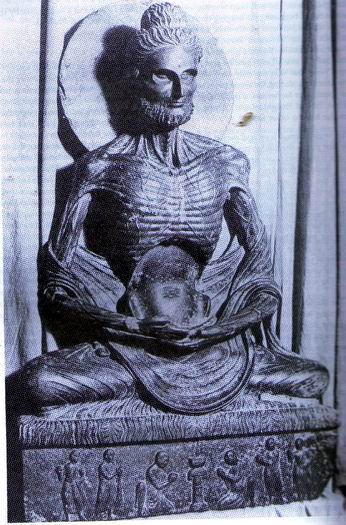
Wednesday, October 10

On Being Difficult: Wind Through A Skull

Bone Dragon by Dan Kuzmenka


+ Why "Things" Are So Difficult For Me +

Mortals dwell in that they await the divinities as divinities. In hope they hold up to the divinities what is unhoped for. They wait for intimations of their coming and do not mistake the signs of their absence. They do not make their gods for themselves and do not worship idols. In the very depth of misfortune they wait for the weal that has been withdrawn.
- Heidegger

Who among us is not waiting for the weal that has been withdrawn?

+ Self-Usufruct +

http://laughingbone.blogspot.com/2006/01/notes-on-difficulty.html


Ontological Difficulties - Essential questions. The very existence, being, of the thing is in question here. Why was it created? Who is the audience? Why is there performance at all? I think of a spectrum from an autistic savant filling page after page with unreadable language to serial murderers 'decorating' their dungeons to Holy Men chanting mantras in isolated caves.

Because this type of difficulty implicates the functions of language and of the poem as a communicative performance, because it puts in question the existential suppositions that lie behind poetry as we have known it, I propose to call it ontological. Difficulties of this category cannot be looked up; they cannot be resolved by genuine readjustment or artifice of sensibility; they are not an intentional technique of retardation and creative uncertainty (though these may be their immediate effect). Ontological difficulties confront us with blank questions about the nature of human speech, about the status of significance, about the necessity and purpose of the construct which we have, with more or less rough and ready consensus, come to perceive as a poem.

- George Steiner


This is certainly the most interesting type of difficulty. Perhaps the most vital to my outwardly formed interpretation. To exploring a life lived and died as a poem of sorts. I realize now that the difficulties that I have had in coming to terms with the death of B. Jones are mostly of the ontological type. His life was/is like a poem to me. And I guess the crux of the difficulty is in that tense change marked by /. Because I don't/didn't want the poem to ever end.

+ I Dream of A Dragon in the Main Cardoid Bulb of the M-Set +

Are you familiar with the Mandelbrot set? It is the set of points that defines a fractal. All stemming from a beautifully elegant equation: Z ⇋ z² + c. There is a large heart shaped blackness that attracts one set of points and another smaller bulb which has another attracting cycle. Together they from a sort of Buddha-scarab, the edges of which generate an infinite number of fractals.

http://laughingbone.blogspot.com/2007/10/buddhabrot-do-not-filter-out-non.html


As you "zoom" into any one aspect of these fractals, new iterations are formed around new Buddha-scarabs, infinitely. Soon you forget the presence of the blackness as each new iteration of the fractal forms around it.

Lately, I am unable forget the blackness at the center.

I had a dream once about these fractals. Instead of the a Buddha-scarab, it was a Dragon. And the fractals burning off of its edges were language. As I fell deeper and deeper into the infinite fractal fires, I could sense the Dragon becoming aware of me. And a horror dawned over me that the Dragon was an Abyss.

Language was fractally burning off the edges of a Great Dragon of Nothingness. Every word, every meaningful set of sounds, was predicated upon Nothing. And I woke up covered in sweat, filled with a nameless fractaling fear.

Along these lines, I also once dreamed of words as small children chasing after a wagon of reality, most often never reaching it, but, every now and again, hopping up onto the bed of the wagon and riding for a little while. You imagine the most sublime poem. And each word of it is a laughing kid in the back of that wagon - which because of the weight is threatening to fall apart.

A few times in my life, moments that have defined my being, I have touched the back of that wagon.

What disturbed me so much in my dream of the Dragon and language was that my wagon of reality that underwrote language, that gave words their deepest ontological meaning, was No-Thing. Language had nothing underneath it, inside of it, around it. Smoke in a universe composed entirely of mirrors.

I have talked to you about the sound of particular words. How "glad" is such a Stepford Wife word to describe a state of being. How "happy" is such a goofy kangaroo word. But what happens when a word such as "hope" sounds like the wind through a skull, a last breath, a time-lapsed collapse of a bone into dust? What happens to someone who cannot speak in a future tense? When every word is a solitary being in the middle of a black ocean constantly terrified by the dual immanent threats of going under and the sharks of silence?

Of course, I am smiling at my tortured metaphors.

My difficulties seem to leave me little recourse. I fall back upon black irony and gallows humor. But it comes down upon me all too heavily. I kneel for hours before an Altar of the Abyss that allows no language, no prayer, no song, word, sound, cry, sigh, scream or death rattle. My mouth is filled with dust. And my entire being with the absence of what was once present. God has withdrawn from the world. And I feel it like a hammering upon my skull.

+ Absence in Presence +

It is not so much the poet who speaks, but language itself: die Sprache spricht. The authentic, immensely rare, poem is one in which 'the Being of language' finds unimpeded lodging, in which the poet is not a persona, a subjectivity 'ruling over language', but an 'openness to', a supreme listener to, the genius of speech. The result of such openness is not so much a text, but an 'act', an eventuation of Being and literal 'coming into Being'. [...]

We bear witness to its precarious possibility of existence in an 'open' space of collisions, of momentary fusions between word and referent. The operative metaphor may be that crucial to Mallarme's famous L'absente de tous bouquets, to the modem physicist's determination of 'the unperceived event' in the cloud-chamber, and to Heidegger's equivocation on the 'absence in presence' (the play on Ab- and Anwesen). ln each case the observable phenomenon - the text - is the inevitable betrayal, in both senses of the term, of an invisible logic.

- More Steiner

+ Two Very Short Uneasy Pieces Burning Inside My Skull +

The Transcendental Pretense of Feigenbaum Constants

Lying in the middle of her cosmic legs
Dive into a puddle of some scrambled eggs
Back in the bedroom
Melt in the full moon
Howl with the possum
He's playing a good tune
Sit with me baby, up here on the fence
Try to make some sense of the Transcendental Pretense.

How Many Planck Lengths Long is God's Cock?

"She said she wanted to know what it was that I wrote about. I told her: the essential human condition from hole to hole. Hole to hole? she asked. Yep: womb to tomb. All about the Dance of the Bone out of one and then into another. Dance of the Bone? she asked, not following. You and me, bones dancing inside bags of skin. That's not a very pretty picture, she said. I disagree, I replied. Nothing prettier than a lil pink bone hole waiting for you at the end of the day. I'm sorry, she started to say. But I cut her off and I asked her, do you know why an electron isn't a black hole? Of course, she had no answer. She replied that it sounded like a joke, you know, with a funny punchline. I said, actually, the punchline is kind of funny because an electron can't be smaller than Planck's length. She laughed and said that was silly because she has seen lots of planks bigger than an electron. I laughed too. It was really funny. Then I asked her how many Planck's Lengths long she imagined god's cock to be? Well, I've never thought of God as having a cock, she said slowly, the notion sinking in, but I imagine a lot. I said, I can show it to you, if you really want to see it. She looked at me, wide-eyed. And then said the most beautiful thing: how long will it take. I smiled and said, Sweetheart, as long as you like."

+ Van der Waalsian Connections +

Colors of Infinity:
http://video.google.com/videoplay?docid=-3034959314635185121

+ Evidence +

http://www.youtube.com/watch?v=ivRQDbAduoM

http://www.youtube.com/watch?v=G_GBwuYuOOs

+ A Caesium Moment of Humor +

The Mandelbrot Set Song
http://www.youtube.com/watch?v=gEw8xpb1aRA

Pathological monsters! cried the terrified mathematician
Every one of them is a splinter in my eye
I hate the Peano Space and the Koch Curve
I fear the Cantor Ternary Set
And the Sierpinski Gasket makes me want to cry
And a million miles away a butterfly flapped its wings
On a cold November day a man named Benoit Mandelbrot was born.

+ Loomings +

http://web.mit.edu/newsoffice/2006/fractals.html

Mandelbrot recently began to apply his knowledge of fractals to explain stock markets. "Markets, like oceans, have turbulence," he said. "Some days the change in markets is very small, and some days it moves in a huge leap. Only fractals can explain this kind of random change." He and a journalist, Richard Hudson, have co-written a book on the thorny subject to explain the complex gyrations of stock prices and exchange rates.


+ Looks Back Into You +

Dangerous Knowledge
http://bestdocumentaries.blogspot.com/2007/09/dangerous-knowledge-full-documentary.html

The film begins with Georg Cantor, the great mathematician whose work proved to be the foundation for much of the 20th-century mathematics. He believed he was God's messenger and was eventually driven insane trying to prove his theories of infinity. Ludwig Boltzmann's struggle to prove the existence of atoms and probability eventually drove him to suicide. Kurt Gödel, the introverted confidant of Einstein, proved that there would always be problems which were outside human logic. His life ended in a sanatorium where he starved himself to death.


+ After Words +

http://www.azibaza.com/lecture/images/Image-03.jpg


❂

Sunday, August 19

The Zen of Otis on Andy Griffith


Andy: Otis, what in the world are you doin'?
Otis: I just got back from old man Davis's place and he sold me this entire horse for twenty dollars.
Andy: Otis, I don't reckon you can notice, but you got a horse that gives milk.
Otis: I knew he was a good buy.

Been curiously fascinated with the Andy Griffith Show recently. About the world that it existed within. About the world that it mirrored.

From Wikipedia:

The Andy Griffith Show was set in and around the fictional town of Mayberry in the county of Mayberry, North Carolina. (Andy and Barney were employees of Mayberry County.) According to roadside signs seen in various episodes, the town population varied between 2,000 and 5,360 during the eight seasons of The Andy Griffith Show. Raleigh was a few hours' drive away but the nearest city was Mount Pilot, located to the east of Mayberry in Pilot County. Mt. Pilot had a population of 30,000 and was known for its fast pace. Another nearby city mentioned numerous times on the show is Siler City, in Chatham County. It is also the town where Frances Bavier, the actress who played Aunt Bee, retired and was buried. One episode had a fictional neighboring district called "Pierce County" near Mayberry County.

There is no real town of Mayberry, but despite Griffith's denial, it is widely believed that it was based upon his real hometown of Mount Airy in Surry County, North Carolina. (In one 1965 episode, "Aunt Bee's Invisible Beau," he can be seen perusing a copy of the Mount Airy News [1] in his living room.) More likely, Mayberry was the brainchild of not only the writers, directors, and producers of The Andy Griffith Show, but also of the several other actors besides Griffith who hailed originally from southern towns and cities (e.g. Don Knotts from Morgantown, West Virginia, Jim Nabors from Sylacauga, Alabama, and George Lindsey, from Jasper, Alabama).
Mayberry has become synonymous with the peaceful charm and wholesome goodness of small town America. In a negative sense, the term has also been used to connote the ignorance and lack of sophistication often associated with people from rural areas, and as an example of an idealized, fictional white south that never really existed.

Just watched episode 145, The Rehabilitation of Otis, which starts off with Otis riding into town on a cow that he drunkenly believes to be a horse. Later, Barney takes it upon himself to rehabilitate Otis using "psychological" methods he gleaned from a .25 cent magazine. In the end, Otis resists Barney's efforts and receives a warm welcome as he drunkenly rides back into Mayberry on the cow and directly into the courthouse.

It is a beautiful world where the town drunk is allowed to sleep peacefully in the county jail, wake up the next morning with no ramifications from the previous night (other than the comical hangover) and stumble off to get a shave from Floyd the barber. I have a particular fondness for the character of Otis (played to perfection by Hal Smith), especially when he's deep in his cups. Echoes of a Holy Fool, spinning wisdom under the guise of intoxication/ madness. Like the Fool in Lear, he has the best lines - at least, the funniest - and is immune from their repercussions.

Anyway, three times in this episode, Otis is found riding his cow that he believes a horse. The first time is the humorous entrance, then when he falls off the wagon and, finally, in a sort of triumphant return. I thought the parallels to the Zen Ox-Herding Series of Kakuan were amusing to contemplate and, not wanting to already stretch this already threadbare argument, present only a couple of instances here. (Oh I could go on.)


6. Riding the Bull Home

Mounting the bull, slowly I return homeward.
The voice of my flute intones through the evening.
Measuring with hand-beats the pulsating harmony,
I direct the endless rhythm.
Whoever hears this melody will join me.


10. In the World

Barefooted and naked of breast, I mingle with the people of the world.
My clothes are ragged and dust-laden, and I am ever blissful.
I use no magic to extend my life;
Now, before me, the dead trees become alive.

Friday, August 3

The only thing bigger is the sky...

Traveling: I-10 West to Las Cruces, New Mexico. Big sky everywhere. Burning with blue. Then, big enough to see more than five storms falling.


Zeb Calloway: I remember once there being a trapper named Parker. He run smack into a big grizzly bear. The bear sure made a mess out of Parker before we killed it. Ripped one of his ears clear off. But this child just happened to have a needle and some of this deer sinew, just like we got here. Yeah, while his ear was still hot, I picked it up and sewed it back on his head. And it growed most as good as ever.

[...] I said growed most as good as ever. Not hardly. It seems I sewed Parker's ear on backwards. Yeah, he hated me until the day he died, on account of every time he heared a rattlesnake, he'd turn the wrong direction and step smack into it!
From the film The Big Sky (1952), directed by Howard Hawks, based on the novel of the same name by A.B. Guthrie Jr..

Monday, June 25

Where is the drink you promised me?


“WHAT do you think
The bravest drink
Under the sky?”
“Strong beer,” said I.

“There’s a place for everything,
Everything, anything,
There’s a place for everything
Where it ought to be:
For a chicken, the hen’s wing;
For poison, the bee’s sting;
For almond-blossom, Spring;
A beerhouse for me.”

“There’s a prize for every one
Every one, any one,
There’s a prize for every one,
Whoever he may be:
Crags for the mountaineer,
Flags for the Fusilier,
For English poets, beer!
Strong beer for me!”

“Tell us, now, how and when
We may find the bravest men?”
“A sure test, an easy test:
Those that drink beer are the best,
Brown beer strongly brewed,
English drink and English food.”

Oh, never choose as Gideon chose
By the cold well, but rather those
Who look on beer when it is brown,
Smack their lips and gulp it down.
Leave the lads who tamely drink
With Gideon by the water brink,
But search the benches of the Plough,
The Tun, the Sun, the Spotted Cow,
For jolly rascal lads who pray,
Pewter in hand, at close of day,
“Teach me to live that I may fear
The grave as little as my beer.”


“What is Maya?” asked Narada, the devoted student.

“The world is my Maya. He who accepts this, realizes me,” said Vishnu. “Before I explain further, will you fetch me some water?” requested the Lord pointing to a river.

Narada did as he was told. But on his way back, he saw a beautiful woman. Smitten by her beauty, he begged the woman to marry him. She agreed.

Narada built a house for his wife on the banks of the river. She bore him many children. Loved by his wife, adored by his sons and daughters, Narada forgot all about his mission to fetch water for Vishnu.

In time, Narada’s children had children of their own. Surrounded by his grandchildren, Narada felt happy and secure. Nothing could go wrong.

Suddenly, dark clouds enveloped the sky. There was thunder, lightning, and rain. The river overflowed, broke its banks and washed away Narada’s house, drowning everyone he loved, everything he possessed. Narada himself was swept away by the river.

“Help, help. Somebody please help me,” he cried. Suddenly, Narada awoke face down in the desert sand under the blazing sun. The flooded river was nowhere to be seen. He heard a voice: "My son, where is the drink you promised me? It's been half an hour since you went to fetch it for me!"

“How can you be so remorseless? How can you ask me for water when I have lost my entire family? Narada responded.

Vishnu smiled. “Calm down, Narada. Tell me, where did your family come from? From Me. I am the only reality, the only entity in the cosmos that is eternal and unchanging. Everything else is an illusion – a mirage, constantly slipping out of one’s grasp.”

“You, my greatest devotee, knew that. Yet, enchanted by the pleasures of worldly life, you forgot all about me. You deluded yourself into believing that your world and your life were all that mattered and nothing else was of any consequence. As per your perspective, the material world was infallible, invulnerable, perfect. That is Maya.”


Amazon Links:
Fairies and Fusiliers by Robert Graves
Teachings of Sri Ramakrishna

Thursday, June 21

Skull Scooter


After Compline: 20 October 2004


Half moon hung up in the sky
Wreathed with clouds like Nine Chinese Dragons,
Illuminating a path before me,
Shadows shifting on canyon walls.

Of the times I've been here,
I've never noticed that.
I walk along, shadows shift
From a Skull to Sphinx to King.

Enormous silence,
Not an in-breathing suspension
But an absence of breath entirely.

The monks are simple, spiritual.
The place is terrible, sacred -
Haunted by god's presence
More than any I have ever known.

Yet, I was born in this beautiful tomb.


Tuesday, March 27

Tacitus did not perceive the Crucifixion.

From the excellent Giornale Nuovo

Been thinking a lot about the origins of Greek tragedy. Readings in Steiner's Antigones and The Death of Tragedy.

There is an illuminating passage in Borges' Other Inquisitions regarding the introduction of the second actor as one of the most significant events in human history:

"I have suspected that history, real history, is more modest and that its essential dates may be, for a long time, secret. A Chinese prose writer has observed that the unicorn, because of its own anomaly, will pass unnoticed. Our eyes see what they are accustomed to seeing. Tacitus did not perceive the Crucifixion, although his book recorded it.

Those thoughts came to me after a phrase happened to catch my eye as I leafed through a history of Greek literature. The phrase aroused my interest because of its enigmatic quality: "He brought in a second actor." I stopped; I found that the subject of that mysterious action was Aeschylus and that, as we read in the fourth chapter of Aristotle's Poetics, he "raised the number of actors from one to two." It is well known that the drama was an offshoot of the religion of Dionysus. Originally, a single actor, the hypokrites, elevated by the cothurnus, dressed in black or purple and with his face enlarged by a mask, shared the scene with the twelve individuals of the chorus. The drama was one of the ceremonies of the worship and, like all ritual, was in danger of remaining invariable. Aeschylus' innovation could have occurred on but one day, five hundred years before the Christian era; the Athenians saw with amazement and perhaps with shock (Victor Hugo thought the latter) the unannounced appearance of a second actor. On that remote spring day, in that honey-colored theatre, what did they think, what did they feel exactly? Perhaps neither amazement nor shock; perhaps only a beginning of surprise. In the Tusculanae it is stated that Aeschylus joined the Pythagorean order, but we shall never know if he had a prefiguring, even an imperfect one, of the importance of that passage from one to two, from unity to plurality and thus to infinity. With the second actor came the dialogue and the indefinite possibilities of the reaction of some characters on others. A prophetic spectator would have seen that multitudes of future appearances accompanied him: Hamlet and Faust and Segismundo and Macbeth and Peer Gynt and others our eyes cannot yet discern."

From http://www.wayneturney.20m.com/AESCHYLUS.htm

Innovations: Introduction of the Second Actor. Judging from his earliest surviving plays, Aeschylus added a second actor at first not so much to increase conflict, as to advance the story (as opposed to the plot) by introducing new material while adding visual and aural variety to his plays. The messenger telling Atossa of the death of her son Xerxes in the Persians is thus the oldest extant "messenger speech." It clearly heightens the emotion, but creates involves no agon. The fellow who took the role of this "second" actor is, then, the first professional actor and we happen to know his name-Kleander (but, alas we know nothing else about him). This marks also the first stage of the decline of prominence of the khoros, a literary event that can be traced through Sophokles and Euripides and which was to have very far reaching consequences indeed.
From Aeschylus and His Tragedies

The closing years of the life of Aeschylus were passed in Sicily, which country he first visited soon after his defeat by Sophocles. At Syracuse his Persæ was several times performed at the request of the king, and here also he brought out his Women of Etna, celebrating the foundation of that city by Hiero and prophesying happiness for its inhabitants. Returning to Athens, he produced his Orestean trilogy, probably the finest of his works; but the Eumenides, the last of the three plays, revealed so openly his aristocratic tendencies that he became extremely unpopular, and returning to Sicily, died soon afterward at Gela. The story as to the manner of his death, that an eagle, mistaking his bald head for a stone, dropped a tortoise upon it to break the shell, is the sheerest fabrication, and, it would seem, entirely unnecessary to account for the natural death of an exile nearly seventy years of age.


Amazon Links:

The Oresteia: Agamemnon; The Libation Bearers; The Eumenides by Aeshylus
The Three Theban Plays by Sophocles

Sunday, March 11

Initial Thoughts on Re-entering Gravity's Rainbow


Back in the early 80s, a friend presented me with a copy of Thomas Pynchon's Gravity's Rainbow saying something to the effect that all the lamentation over the death of the novel since Joyce is now appeased by this book. Read it.

I must confess that I, like many others, waded in to about page 100 and set it down. That gold Bantam paperback sat there on my shelf for many years, occasionally catching my eye like a lost lover. But I never picked it back up. Over that time, I did read V, The Crying of Lot 49 and Slow Learner. Gravity's Rainbow hovered: still unread.

A few months ago, I found myself combing through the bookshelves for my copy. It seemed to have disappeared. No matter. I figured that I would easily find a copy at a used bookstore. After several stores in several states, I came to understand that used copies of GR were not so easy to find. So I bit the bullet and biked over to the nearest chain to buy a new one.

Entirely unrelated was my interest in the film 300. I wanted to read Miller's graphic novel before seeing the film. I found 300, a beautiful Penguin Deluxe Edition of GR, and A Gravity's Rainbow Companion: Sources And Contexts for Pynchon's Novel.

Later that evening, after finishing Miller's 300. I picked up GR and the Companion and started in again. As often happens with me these days, it was suddenly a new book. I wondered at the idiot who set it down so long ago. Who was that person? The prose style was stunning, immediately accessible and entertaining. I quickly forgot about my concurrent reading in the Companion and sailed past page 100 finding it difficult to put down. Closing the book, I studied the cover, a sort of splatter abstraction with an outline of falling rocket, turned to the back flap to see if, perhaps, it was a Jackson Pollock. Lo and behold, it was Frank Miller - of the 300. A happy synchronicity.

I then decided to catch up to where I was with the Companion and not but a few pages into that found the author quoting Chaplin's Look Up, Hannah! speech from The Great Dictator. The same speech I posted on the Laughing Bone a short time ago.

I don't think there is anything terribly meaningful about these coincidences. But you sense a part of your self being rung when they occur. When they happen within the pages of a book, it is a beautiful thing. There is laughter in the room. Time outside the book fades. It seems you are reading yourself, that your blood, your innermost self, burns through the letters of the words. And it may be damning, but some of the most important moments of my life have occurred in such a manner, between the covers, inside the pages and deep within the words.

Tuesday, February 20

Trying To Speak Towards: What Is Uncovered

It is all about those unburied corpses...

Undergoing a deeper reading of Antigone along with Steiner's critical analysis.

All three of the Theban plays have been resonate for me lately. The hauntings of old men late at night.

Sophocles wrote Antigone, the first of the three, in his early 50s? And Oedipus at Colonus in his late 80s....

Getting to the point of understanding what it is to "say a thing" - soon perhaps even to spell out the signs that point to that saying.

Working on a long piece on the death of B. Jones where he is the unburied corpse of Polynices and there is a sort of fractured first-person Rashoman narration of the Antigone role - instead of the primary dialectic being between the individual and the state, it is between the individual and God.

Delighted by the allusive undertones in Anti-Gone - referencing those Bones of God that I go on about all the time.

God is dead but not gone - haunting us. Those Heideggerian fugitive traces. The Devil wearing the Godshoes.

Also, a thing about the death of Paul Celan - the story of his bones and flesh between April 20th and May 1st 1970 - those seven miles in the Seine - the Shakesperian sea-change.

From Felstiner:
[I]n 1964 he had written:

Water needles
stitch up the split
shadow- he fights his way
deeper down,
free.

About 20 April 1970, around Passover, Celan went from the bridge into the Seine and, though a strong swimmer, drowned unobserved.... On 1 May a fisherman came upon his body seven miles downstream.

A biography of Holderlin was found then on Celan's desk, open to an underlined passage: "Sometimes this genius goes dark and sinks down into the bitter well of his heart." Celan did not, I noticed, underline the rest of that sentence in the Holderlin biography: "but mostly his apocalyptic star glitters wondrously."

People have said that Celan took his own life at forty-nine because valid speech in German was impossible after or about Auschwitz. Yet this was the impossibility that incited him: "Spills of mire I swallowed, inside the tower." And he did speak - more validly than could ever have been imagined.

Tuesday, January 23

Usufruct: A tattered coat upon a stick

Moby Dick, Ricciardelli
From rebella


Been reading a good biography of the poet Charles Olson. He first caught my attention with his book on Melville and Moby Dick, Call Me Ishmael. That book opened up Moby Dick for me in a new way: when I re-read (for the 3rd time) the book immediately after, it was a bright and shining thing for me. Olson showed me a form a primary critique – what he calls “usufruct”.

I have always had a problem with criticism in that it is such a parasitic act - needing the the primary artifact of a creator upon which to enact its own "creation". Better to respond to a work of art with another work of art - as Vergil critiqued Homer with the Aeneid, as Dante critiqued Vergil with the Commedia. (cf. Steiner's Real Presences)

I always wonder why so many are satisfied with secondary critique - even extending this to a way of life. They would rather have their information "digested" for them like helpless birdlings in nests of ignorance. They prefer processed pabulum over the whole and the raw and the "right from the earth". I find it bizarre that people place so much faith in what the media(tors) give them; that they have never read even a portion of the Bible or the Koran or Moby-Dick or the Constitution; that they have never had even a slight conversation with a homeless person, a monk, a priest, a Buddhist, a Muslim, a criminal.

It is astounding how sheltered and insulated most are from the Primary. And yet, I have the fear of becoming like one of them. As time goes on and I go on in it, I feel the mounting pressures of conformity, of habituation, of desensitization. Every day seems more and more the same. And the disciplines one practices to hold on the face-to-face seem to be increasingly absurd. Why not just give in? It would be so easy.

Yeats wrote of difficulties brought about through the awareness of having an eternal spirit tied to the body of a dying animal. I think of a balloon tied to the tail of a old dog. Most of my days have been "spent" in the attempt to grasp that balloon. But I must admit the fear, the cold wet first thing in the morning fear, of how good settling into these bones feels, to ignoring the balloon, the spirit and coming to terms with the fact that I will live out the remainder of my days as a stupid dying animal.

Sailing to Byzantium

That is no country for old men. The young
In one another's arms, birds in the trees -
Those dying generations - at their song,
The salmon-falls, the mackerel-crowded seas,
Fish, flesh, or fowl, commend all summer long
Whatever is begotten, born, and dies.
Caught in that sensual music all neglect
Monuments of unageing intellect.

An aged man is but a paltry thing,
A tattered coat upon a stick, unless
Soul clap its hands and sing, and louder sing
For every tatter in its mortal dress,
Nor is there singing school but studying
Monuments of its own magnificence;
And therefore I have sailed the seas and come
To the holy city of Byzantium.

O sages standing in God's holy fire
As in the gold mosaic of a wall,
Come from the holy fire, perne in a gyre,
And be the singing-masters of my soul.
Consume my heart away; sick with desire
And fastened to a dying animal
It knows not what it is; and gather me
Into the artifice of eternity.

Once out of nature I shall never take
My bodily form from any natural thing,
But such a form as Grecian goldsmiths make
Of hammered gold and gold enamelling
To keep a drowsy Emperor awake;
Or set upon a golden bough to sing
To lords and ladies of Byzantium
Of what is past, or passing, or to come.

-- William Butler Yeats


What always saves me is the Mystery - the continual, as yet unsolvable allegory that I have involved myself in. Call it God, Allah, Nirvana, Samadhi, Atman, Real Presence, Ishmael, a White Whale or a Red Ballon - it is what keep these bones burning.