Tuesday, January 23

Usufruct: A tattered coat upon a stick

Moby Dick, Ricciardelli
From rebella


Been reading a good biography of the poet Charles Olson. He first caught my attention with his book on Melville and Moby Dick, Call Me Ishmael. That book opened up Moby Dick for me in a new way: when I re-read (for the 3rd time) the book immediately after, it was a bright and shining thing for me. Olson showed me a form a primary critique – what he calls “usufruct”.

I have always had a problem with criticism in that it is such a parasitic act - needing the the primary artifact of a creator upon which to enact its own "creation". Better to respond to a work of art with another work of art - as Vergil critiqued Homer with the Aeneid, as Dante critiqued Vergil with the Commedia. (cf. Steiner's Real Presences)

I always wonder why so many are satisfied with secondary critique - even extending this to a way of life. They would rather have their information "digested" for them like helpless birdlings in nests of ignorance. They prefer processed pabulum over the whole and the raw and the "right from the earth". I find it bizarre that people place so much faith in what the media(tors) give them; that they have never read even a portion of the Bible or the Koran or Moby-Dick or the Constitution; that they have never had even a slight conversation with a homeless person, a monk, a priest, a Buddhist, a Muslim, a criminal.

It is astounding how sheltered and insulated most are from the Primary. And yet, I have the fear of becoming like one of them. As time goes on and I go on in it, I feel the mounting pressures of conformity, of habituation, of desensitization. Every day seems more and more the same. And the disciplines one practices to hold on the face-to-face seem to be increasingly absurd. Why not just give in? It would be so easy.

Yeats wrote of difficulties brought about through the awareness of having an eternal spirit tied to the body of a dying animal. I think of a balloon tied to the tail of a old dog. Most of my days have been "spent" in the attempt to grasp that balloon. But I must admit the fear, the cold wet first thing in the morning fear, of how good settling into these bones feels, to ignoring the balloon, the spirit and coming to terms with the fact that I will live out the remainder of my days as a stupid dying animal.

Sailing to Byzantium

That is no country for old men. The young
In one another's arms, birds in the trees -
Those dying generations - at their song,
The salmon-falls, the mackerel-crowded seas,
Fish, flesh, or fowl, commend all summer long
Whatever is begotten, born, and dies.
Caught in that sensual music all neglect
Monuments of unageing intellect.

An aged man is but a paltry thing,
A tattered coat upon a stick, unless
Soul clap its hands and sing, and louder sing
For every tatter in its mortal dress,
Nor is there singing school but studying
Monuments of its own magnificence;
And therefore I have sailed the seas and come
To the holy city of Byzantium.

O sages standing in God's holy fire
As in the gold mosaic of a wall,
Come from the holy fire, perne in a gyre,
And be the singing-masters of my soul.
Consume my heart away; sick with desire
And fastened to a dying animal
It knows not what it is; and gather me
Into the artifice of eternity.

Once out of nature I shall never take
My bodily form from any natural thing,
But such a form as Grecian goldsmiths make
Of hammered gold and gold enamelling
To keep a drowsy Emperor awake;
Or set upon a golden bough to sing
To lords and ladies of Byzantium
Of what is past, or passing, or to come.

-- William Butler Yeats


What always saves me is the Mystery - the continual, as yet unsolvable allegory that I have involved myself in. Call it God, Allah, Nirvana, Samadhi, Atman, Real Presence, Ishmael, a White Whale or a Red Ballon - it is what keep these bones burning.

Tuesday, January 3

Easy's Getting Harder Every Day

Just posted my long, semi-confessional interpretation of George Steiner's essay On Difficulty on The Laughing Bone. I wonder if I will ever get over this strangeness of posting to Jones's weblog? Feels like wandering through someone else's house. But I know that it is what he would have wanted. I also made a post on Osteo Logos of a recording I found of what has to be a young B. Jones playing a ukulele and singing a song called Mississippi Pickup that he wrote based on a story by Hunter Kennedy. I thought it was highly amusing.

Yesterday I received a disconcerting letter from B. Jones' sister, Nora. She wrote that while she appreciated how much I had done for her brother, she was concerned about some of the work that I might choose to post on the blog.

I will state here publicly that Charles Jones explicitly stated to me that I was to be the sole guardian of his creative works and that he trusted me to publish or not publish them as I see fit. And while I will certainly do my best to exercise the utmost discretion with regard to the privacy of other's lives, I will not be censored in any way.

Yes, difficulties. Seems appropriate to let Iris Dement finish it:

I had a garden but my flowers died.
There ain't much living here inside.
And lately, I don't know what I'm holding on to.
But I'll never make it up to Couer d'Alene.
There ain't no chance of me forgetting my name.
And easy's gettin' harder every day

And it feels like easy, just keeps on gettin' harder every day.

Friday, December 23

On Mirrors

Tiajuana TV
Shelton Walsmith


Just posted The Vision of God Laughing on The Laughing Bone. I do not believe that it would've been against the wishes of B. Jones, but I do know that he would've considered it of no real value as far as "publishing" it for anyone else. His mirror comment regarding this, that why would anyone care to look into a mirror that was made only for him, as always, got me to thinking about the nature of creating artifacts in general.

I mean, doesn't the fact that an artist feels the need to create something other-than-what-is indicate a fundamental dissatisfaction with what-is? There is, of course, a sort of inherent selfishness in all acts of creation - a desire to mark your passing through the world - whether is be in the form of a child or a painting. I guess the crucial question then is how much your "mark" gives back to the world, adds to it, and increases its value. Would the world have been more or less meaningful without Michelangelo's painting in the Sistine Chapel and with a family of his children?

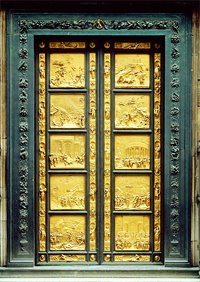
A priest once remarked to Michelangelo that it was a shame he had never married and produced children to whom he could bequeath his works. "I have too much of a wife in this art of mine, which has afflicted me throughout my life," Michelangelo replied, "and my children shall be the works I leave. What would have become of Lorenzo Ghiberti's reputation if he had not made the gates of San Giovanni? His children and grandchildren sold or squandered all he left, but the gates are still standing."
- G. Vasari, Lives of the Painters

Gates of Paradise, Baptistry of San Giovanni
Lorenzo Ghiberti


I return to the mirror metaphor. I know without doubt that I cannot see what B. Jones saw in The Vision of God Laughing. However, it is not entirely opaque to me. I do see something that resonates with deeper aspects of my self. Perhaps this is merely the archetypal form that Jones claimed to have stolen from other works. But he, some essential aspect of who he was, is in there also. And this interior richness, resonance, with the created thing is what opens it up; maybe not as a mirror, but at least as a window.

"I was always afraid of mirrors. I had three large mirrors in my room when I was a boy and I felt very acutely afraid of them, because I saw myself in the dim light - I saw myself thrice over, and I was very afraid of the thought that perhaps the three shapes would begin moving by themselves ... I have always been afraid ... of mahogany, of crystals, even of limpid water."
- Borges

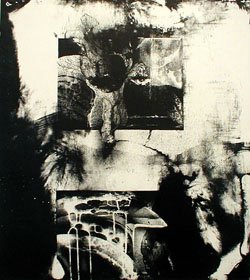
Mirror A (Dedicated to Borges)
Michiko Hoshino, lithograph, 1978

Thursday, December 22

Mythistorema

After my last two posts on The Laughing Bone, I noticed that B. Jones' name was being tagged the bottom. In my attempt to correct this, it seems that I was compelled to start my own blog. I guess that there are not too many occassions where a blog is continued after a person's death. Anyway, since it was here, I thought that I might as well post something every so often regarding the efforts I am making to publish the archives of B. Jones.


I don't imagine I will have much time to write anything of interest here - certainly nothing on the level of the postings of B. Jones.

I will leave off with a short piece from one of B. Jones' favorite poems by the Greek poet, George Serferis. This is from the Mythistorema:

I woke with this marble head in my hands;
it exhausts my elbows and I don’t know where to put it down.
It was falling into the dream as I was coming out of the dream
so our life became one and it will be very difficult for it to disunite again.

I look at the eyes: neither open nor closed
I speak to the mouth which keep trying to speak
I hold the cheeks which have broken through the skin.
I don’t have any more strength.

My hands disappear and come toward me
Mutilated.